It's hard to believe, given the impact that the Austro-Hungarian Empire has had in our history and popular imagination, that it actually only lasted for fifty years or so, from the late-mid 19th century to the end of World War I, when the empire was defeated and broken down into pieces. While it existed, however, it became the second largest "country" in Europe, after the Russian empire, and fomented cultural exchange, both across the lands and people it ruled over and among social classes. Thus, we see dishes travel from one corner of the empire to another, and upper classes adopt peasant dishes and vice-versa. For example, there is still a controversy as to whether Wiener Schnitzel, originated in northern Italy (as the famous milanesas, later imported to Latin America) and was brought to Vienna or vice-versa. While the dish was a favorite of Emperor Franz Joseph, it was also available to peasants, at least for special occasions, as veal was quite cheap at the time.
Cookbooks aimed to urbanites all classes also became popular at the time, and cookbook authors both recorded existing adaptations of "foreign" dishes and perhaps created them, themselves.
For my quick sojourn into Imperial Austro-Hungarian cuisine, I made:
Paprikás-csirke
Imperial Chicken Paprika
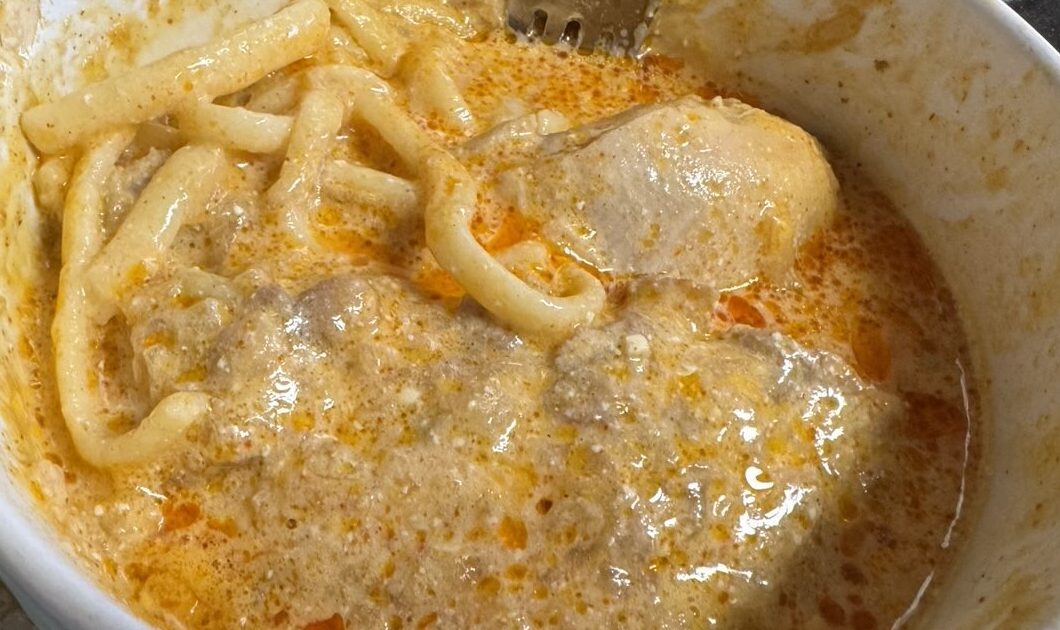
Chicken Paprika originated in Hungary in the early 19th century, perhaps as an adaptation of the peasant dish pörkölt. The addition of sour cream suggests middle class origins, but it was quickly adopted by serf-peasants in the great Hungarian plain. After the Kingdom of Hungary joined Austria in the Austro-Hungarian empire, the dish spread to other territories of the empire. I've made a Czech version in addition to a modern Hungarian and a Hungarian American version so far. The dish is mentioned in Bran Stoker's Dracula as one served to the protagonist while traveling in Transylvania; a version of it is also eaten in neighboring Bulgaria.
The recipe I made was an adaptation by Max Miller of Tasting History of a recipe published in an 1892 Hungarian cookbook. It's simpler than modern versions and reminded me of how successful paprika is at carrying a dish. You can use either sweet or hot paprika, but given the importance of the spice, do use Hungarian paprika.
The 1892 recipe calls for three chickens, cut in parts, and cooked in a liter of water, but the adaptation reduces the chicken to 4 to 5 lbs and the water to just 2 cups. Even then, I ended up with too much sauce for the chicken (and the pasta I served with it). If I made it again, I'd probably use about 7 lbs of chicken (about 12 thighs/legs). I used water rather than the broth suggested by Miller as I wanted to see if broth was really necessary, and I'm happy to say that it was not. The fat and the chicken itself provided enough flavor for the sauce on their own.
As for the fat, the 1892 recipe doesn't specify what type to use but some earlier 19th century descriptions describe the use of rendered bacon fat or butter. Hungarian Jews, whom adopted this dish for their Sabbath meal, probably used schmaltz, or rendered chicken fat, to make the dish kosher. I decided to do likewise, as I had a lot of fat left over after trimming the chicken legs I used. To render the fat, chop it and put it in a small saucepan, barely cover it with water, and simmer it for about an hour. Strain it while still hot, so it doesn't solidify.
All in all, this dish was delicious - worthy of an imperial table, no doubt. Even my picky daughter (now an adult, mind you), really liked it. The 1892 cookbook suggests serving the chicken paprika with tarhonya, a type of pasta, or galuska, a type of dumpling/gnocchi, but I decided to serve them with spätzle as I had some in my pantry. That was a bad idea as the spätzle was too slippery for the sauce. I think I'll eat the leftover sauce with bread.
PRINT PDF
Imperial Chicken Paprika
Ingredients
- 4-5 lbs chicken parts
- salt to taste
- 2-3 Tbsp fat (rendered bacon or chicken fat, lard or butter)
- 2 onions, finely chopped
- 2 Tbsp sweet Hungarian paprika
- 1 1/4 cup sour cream
- 1 Tbsp flour
Directions
Pat chicken dry and season with salt to taste
Heat fat on a saute pan over medium heat. Add the chopped onions. Season with salt to taste. Sauté, stirring occasionally, until the onions are soft and golden. Turn off heat and stir in the paprika. Turn the heat back on to medium, and add the chicken parts. Stir to coat the chicken with the onion. Cook, turning as needed, until lightly brown. Add 2 cups water, reduce heat to medium low and simmer for 30 minutes - stirring every 10 minutes.
Meanwhile, mix the sour cream and flour together in a bowl. When the chicken is ready, add 1 ladle of the broth from the chicken to the bowl with the sour cream and mix well. Stir this mixture into the broth with the chicken. Continue cooking until the chicken is cooked through and the sauce has thickened.
|
Adapted from Max Miller's recipe at Tasting History based on Agnes Zilahy's recipe as published in Valódi Magyar Szakácskönyv, 2nd ed, 1892.
Related cuisines I've explored so far: Austrian, Czech, Croatian, German, Hungarian
Historical cuisines I've cooked so far:
American Colonial, Ancient Persian, Anglo-Saxon, Ante BellumClassical Greek, Cowboy, East German, Elizabethan, Georgian England, Imperial China, Imperial Russian, Italian Renaissance, Medieval English
Do you have a comment on this recipe? Please make it here