Other Cuisines
Marga's Food
marga@lacabe.com
|

The Etruscans were an Iron-Age civilization which flourished in what is now Tuscany and surrounding areas during the first millennium BCE. An autochthonous culture, the Etruscans had strong commercial and cultural connections with other peoples in the region and were the first to import the Phoenician alphabet into Europe, the basis of our own script. Their language, however, was not Indo-European and has not yet been translated. That, coupled with the relatively few writings that we've found, means that most of our knowledge of the Etruscans comes from archaeological remains - including beautiful frescoes in tombs depicting banquets - and the less-than-complimentary writings of Greek and Romans. They saw Etruscans as lazy and frivolous, and accused them of spending all their time feasting. Perhaps not uncoincidentally, the last kings of Rome, who gave rise to the Roman Republic in the 6th century AD, were actually Etruscan.
 Archaeological remains show the evolution of a very rich and complex civilization, with a varied economic base and a highly stratified society, organized into loosely connected city states. Etruscans grew a wide variety of grains, legumes and vegetables which made up the bases of their cuisine; they produced surpluses which they exported for trade. Etruscans were also expert metal workers, and Etruria was one of the few places in the know world back then where tin - an essential component for bronze - could be found. While their use of metals extended to the creation of beautiful and intricate art pieces, they also used it for everyday objects such as cooking pans and utensils. Archaeological remains show the evolution of a very rich and complex civilization, with a varied economic base and a highly stratified society, organized into loosely connected city states. Etruscans grew a wide variety of grains, legumes and vegetables which made up the bases of their cuisine; they produced surpluses which they exported for trade. Etruscans were also expert metal workers, and Etruria was one of the few places in the know world back then where tin - an essential component for bronze - could be found. While their use of metals extended to the creation of beautiful and intricate art pieces, they also used it for everyday objects such as cooking pans and utensils.
Etruscan kitchens, even in elite households, were not as elaborate as Roman ones, but they were amply supplied with grills, spits, stoves and/or ovens, as well as utensils such as mortars, colanders, all sorts of knives, ladles and containers. While no Etruscan recipes have survived, the complexity of their cookware, added to the variety of the agricultural products and livestock Etruscans raised and hunted, suggests they had developed a sophisticated cuisine.
For my quick sojourn into Etruscan cuisine, I made:
Etruscan Chicken
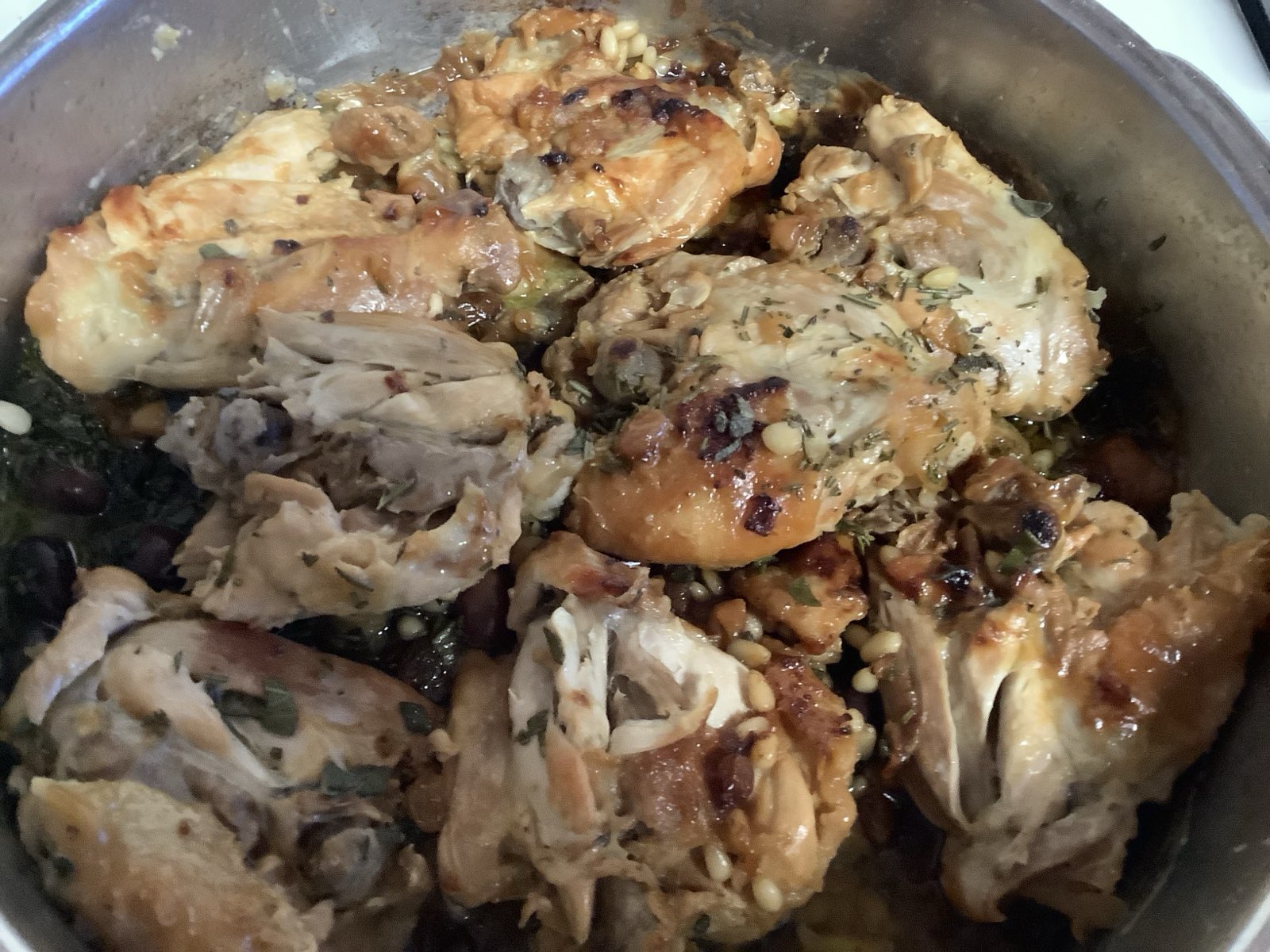
I wasn't able to find the original source of this recipe, but it's clearly made up of food items the Etruscans had ready access to, and can be cooked in equipment similar to what Etruscans had at hand. The flavors are similar to those you can find in Tuscany today. It's rather simple to make and it was pretty tasty, though not extraordinarily so. Still, it makes a satisfying weekday night dinner.
PRINT PDF
Etruscan Chicken
Ingredients
- 8 chicken parts
- 1 Tbsp white wine vinegar
- 1/4 cup olive oil
- 1 red onion, chopped
- salt to taste
- 1 cup white wine
- 1/4 cup pine nuts or almonds
- 1/4 cup raisins
- 1/4 to 3/4 cup black olives
- 2 Tbsp minced rosemary
- 2 Tbsp minced sage
Directions
Place the chicken parts in a large bowl and cover with water. Add the vinegar and set aside.
Heat olive oil in a sauté pan over medium heat. Add the onion and sauté, stirring occasionally, until light brown, about 10 minutes.
Drain the chicken and pat dry. Add the chicken to the pan, skin-side down, and cook until golden. Turn and cook for 3 more minutes. Season with salt to taste. Add the wine, bring to a boil, cover, lower heat to medium-low and simmer for 20 minutes.
Stir in the pine nuts and raisins. Cover, turn temperature to low, and continue cooking for 10 more minutes. Stir in the olives, rosemary and sage. Cover again, turn off heat and let rest for 20 minutes before serving.
|
Adapted from a recipe at Chef Bolek
Related cuisines I've explored so far:
Do you have a comment on this recipe? Please make it here
|

